
Emergency Air Duct Cleaning Near Me: What Magnolia Homeowners Should Do First
If rodents have been living in your duct system and you run your HVAC before it’s cleaned, you’ve just pushed contaminated particulate through every room in the house. That’s the mistake we hear about most, and it’s the one worth avoiding. The first step in a duct emergency isn’t booking a cleaning – it’s shutting the system down so the problem stays where it is. This guide covers the first hour, scenario by scenario, for Magnolia homeowners facing smoke, sewage, rodents, or mold in their ducts.
Why Turning Off Your HVAC Is the First Move in Almost Every Duct Emergency
Shut the system off at the thermostat before you do anything else. A running air handler pulls air from the return ducts, pushes it through the furnace or coil, and delivers it to every supply register in the house. Whatever is in the ducts – smoke residue, rodent droppings and nesting material, sewage-contaminated moisture, mold spores – gets carried along with it. Running the fan to “clear things out” does the opposite. It spreads the contamination from one part of the system into rooms that were previously clean.
Here’s what turning the system off actually accomplishes:
- It stops active distribution of contamination through supply registers.
- It prevents spores and particulate from settling into soft furnishings and carpet in rooms that were unaffected.
- It keeps a contaminated system from drawing air across the furnace heat exchanger or evaporator coil, where residue can bake on or cling to wet surfaces.
- It gives whoever assesses the system a stable starting point instead of a moving target.
Once the system is off, leave the thermostat alone. Don’t run the fan in “on” mode as a workaround, and don’t open windows hoping a cross-breeze will help – in Magnolia, where the marine-influenced humidity keeps outside air fairly damp most of the year, pulling in outside air can add moisture to a problem that’s already about moisture. Call a specialist who can scope the system before anything gets moved or cleaned.
If you’d rather not sort through this on your own, call (877) 309-8232. We answer 24/7, with fast dispatch from 7am to 7pm, Sunday through Friday.
Scenario-by-Scenario: What to Do in the First Hour
The right first response depends on what got into the ducts. Smoke, sewage, rodents, and mold each behave differently inside a duct system, and each calls for a different sequence of containment and assessment.
After smoke damage or a fire nearby
Turn the system off and keep it off. Smoke residue is acidic and oily, and it clings to duct walls, the blower wheel, and the inside of the air handler. Running the system after a fire spreads soot further and can push it into the coil, where it’s much harder to remove. If the fire was in your home, wait for the fire department to clear the structure before you do anything. If smoke drifted in from a neighboring fire, the ducts may still have pulled in residue through the return.
After a sewage backup near ducts
Turn the system off immediately. Sewage carries bacteria, and any ductwork that took on water or splash from a backup needs to be treated as contaminated until it’s assessed. Don’t run fans or a dehumidifier in a way that blows air across the affected area. Keep people and pets out of rooms where the backup happened, and don’t try to clean the ducts with a shop vac – the exhaust from a shop vac pushes fine particulate back into the air.
Confirmed rodent intrusion
Turn the system off. Rodent droppings, urine, and nesting material in a duct system carry pathogens, and the dust that gets stirred up when ducts are disturbed is the real hazard. Don’t vacuum registers with a household vacuum, and don’t run the system to “see if it clears.” Leave the ducts alone until a technician can contain the system and assess the extent of the intrusion.
Suspected mold in the ducts
Turn the system off if you can see visible growth or smell a persistent musty odor at the registers. Mold needs moisture, so the underlying question is where the moisture is coming from – a leak, condensate problem, or high indoor humidity. Cleaning mold without finding the moisture source means it comes back. This is the scenario where duct repair and sealing work matters as much as the cleaning itself.
What a Qualified Emergency Responder Should Actually Do on the First Visit
The first visit is about scope, contain, and assess – not about starting the cleaning. A company that shows up and immediately begins blowing air through a contaminated system has skipped the part that matters most. A proper first visit looks like this:
- Scope the system. A camera inspection shows what’s in the ducts, where it settled, and how far it traveled. That determines the plan.
- Contain the work area. Negative air pressure and filtration keep contamination from migrating into living space while the system is being worked on.
- Assess the source. Rodent intrusion means there’s an entry point. Sewage means there’s a plumbing failure. Mold means there’s moisture. The cleaning is only half the job if the source isn’t identified.
- Document conditions before anything is disturbed. Photos and notes of what was found, where, and in what condition.
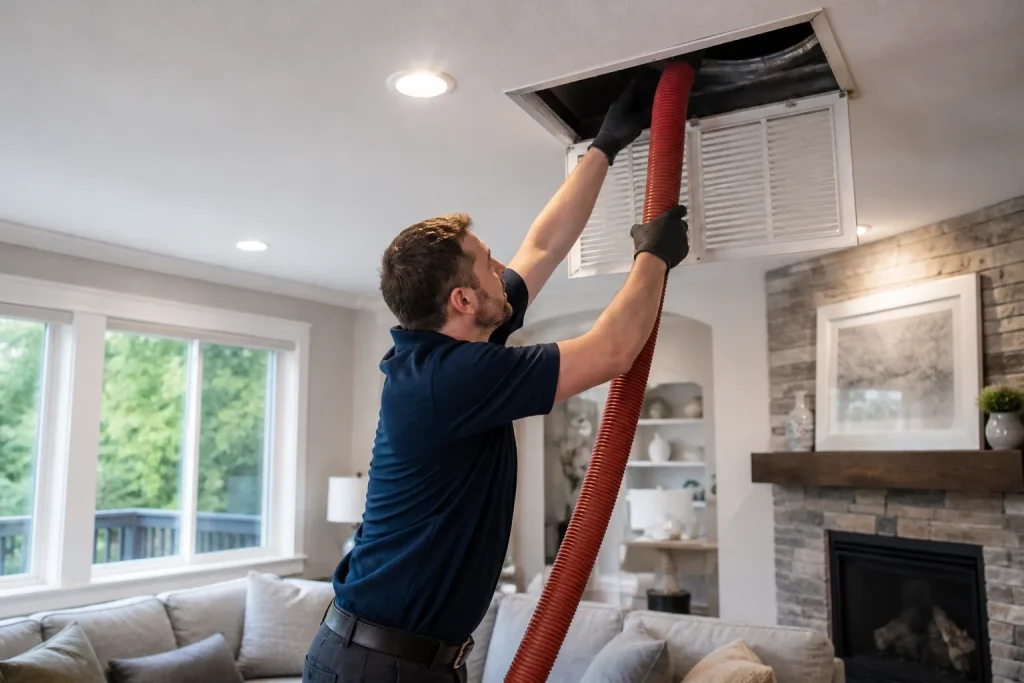
This is where equipment separates a real responder from a standard cleaning operation. Our technicians work with professional-grade Rotobrush and Nikro systems, and we use Abatement Technologies air filtration equipment for contamination and remediation scenarios. That filtration capability is the difference between a crew that can contain a contaminated system and one that can only clean a dirty one. Our technicians have up to 10 years of experience with these systems.
How to Tell If an “Emergency” Duct Company Has the Right Equipment
Ask before you book. A company advertising emergency duct cleaning may only mean it answers the phone quickly. That’s not the same as being equipped for contaminated-system work. Here’s what to ask:
- “What filtration equipment do you bring for a contaminated system?” A real answer names the equipment – Abatement Technologies, for example – not just “our truck.”
- “Do you scope the ducts with a camera before cleaning?” If the answer is no, they can’t tell you what they found or prove what they removed.
- “Can you handle the repair side if you find a breach or an entry point?” Cleaning a system with a rodent entry point and leaving the hole open means the problem returns. We handle duct repair and sealing alongside cleaning for exactly this reason.
- “Will you provide before-and-after photos of our own ducts?” Not stock photos. Yours.
- “Is the price per system or per vent?” One flat price per system, agreed before work starts, is the answer you want.
One light note: if a company’s “emergency kit” is a shop vac and a cheerful attitude, that’s not equipment – that’s a hobby. Duct contamination work needs purpose-built machinery and filtration, and the right tools are the whole conversation.
When to call a pro: If you’ve turned the system off and the source of the contamination isn’t obvious – or if you’re dealing with sewage, smoke, rodents, or visible mold – call us. Estimating is free, and the sooner the system is scoped and contained, the less of the house gets affected. Call (877) 309-8232. We answer 24/7, with fast dispatch from 7am to 7pm, Sunday through Friday.
Documentation Steps Before Any Cleaning Begins
If an insurance claim is possible, document everything before a single duct is touched. Once cleaning starts, the evidence of what was there is gone, and that’s what adjusters need to see. In Magnolia, where many homes are older and duct systems have been modified over the years, the pre-cleaning condition matters even more.
- Photograph the visible damage in every room affected, including registers and returns.
- Photograph the source if you can see it (plumbing failure, entry point, water staining).
- Write down dates, times, and what you observed – smells, sounds, visible contamination.
- Keep receipts for any emergency response or hotel stays if you had to leave the home.
- Ask the technician to document conditions with photos and a written scope before work begins, and ask for a copy.
- Save the written estimate and any invoice. Adjusters want to see the scope that was agreed to.
A qualified responder will hand you documentation rather than making you chase it. We scope, photograph, and write up findings before cleaning so you have a record you can submit to your insurer. We can work with your insurer on the claim – the coverage decision is theirs, but the paperwork trail starts with you and your technician.
Related Services in Magnolia
Once the emergency is contained, the follow-up work usually falls into a few categories. Regular air duct cleaning handles the routine side of system maintenance and is worth scheduling once a contamination problem has been resolved. If a dryer vent was part of the problem or hasn’t been checked in a while, dryer vent cleaning is a separate safety item and one of the leading causes of residential fires. HVAC cleaning covers the coil, blower, and air handler components that ducts feed into. And if the assessment turns up a breach, disconnected run, or rodent entry point, duct repair and sealing closes the gap. All of it sits under the same Magnolia Air Duct Cleaning umbrella – one visit, the full picture.
What happens when you call
- 1
A real person answersNo phone trees – you reach a local pro.
- 2
You get an upfront price rangeHonest numbers before anyone is dispatched.
- 3
A background-checked tech heads outLicensed & insured, dispatched right away.
- 4
You approve before work beginsNothing starts until you say go.
The Bottom Line
In a duct emergency, the first hour matters more than the cleaning schedule. Turn the system off, keep people away from affected rooms, document everything if a claim is likely, and call a company that can scope, contain, and assess before it cleans. The wrong first step – running the HVAC to “clear it out” – is the one that makes the situation worse. Getting the first step right makes everything that follows simpler.
If you’re in Magnolia and need help, Magnolia Air Duct Cleaning offers free estimates – call (877) 309-8232. We answer 24/7, with fast dispatch from 7am to 7pm, Sunday through Friday.
Frequently Asked Questions
Most residential duct cleaning runs on a flat price per system rather than per vent, and contaminated-system work involving filtration and containment typically costs more than routine cleaning because it takes longer and requires different equipment. The written estimate sets the final price, and estimates are free. Call (877) 309-8232 for an exact quote.
Yes. Turn the system off at the thermostat and leave it off until the ducts are scoped. Running the system moves mold spores through the supply registers and into rooms that weren’t affected. The next step is finding the moisture source, because cleaning alone won’t stop it from returning. Call (877) 309-8232 to schedule a free assessment.
Ask for before-and-after photos of your own ducts, taken during the job, plus a written scope of what was cleaned and what was found. A real responder documents conditions because they have nothing to hide. We provide both as part of the job. If a company can’t show you photos of your system, that’s your signal. Call (877) 309-8232 for a free estimate.
The low quote usually covers a different job: surface cleaning without camera scope, no containment, no filtration equipment, and a per-vent price that grows once the technician is on site. For contaminated-system work – smoke, sewage, rodents, mold – cheap equipment isn’t cheaper, it’s just less capable. One flat price per system, agreed before work starts, is the quote worth comparing. Call (877) 309-8232 for a free estimate.
Written by the team at Magnolia Air Duct Cleaning.
Need Air Duct Cleaning Help?
Call Magnolia Air Duct Cleaning - the local pro we connect you with is licensed and insured, here with fast help in Magnolia.
(877) 309-8232